
The Power of Relentless Curiosity: Marie Curie’s Leadership Legacy
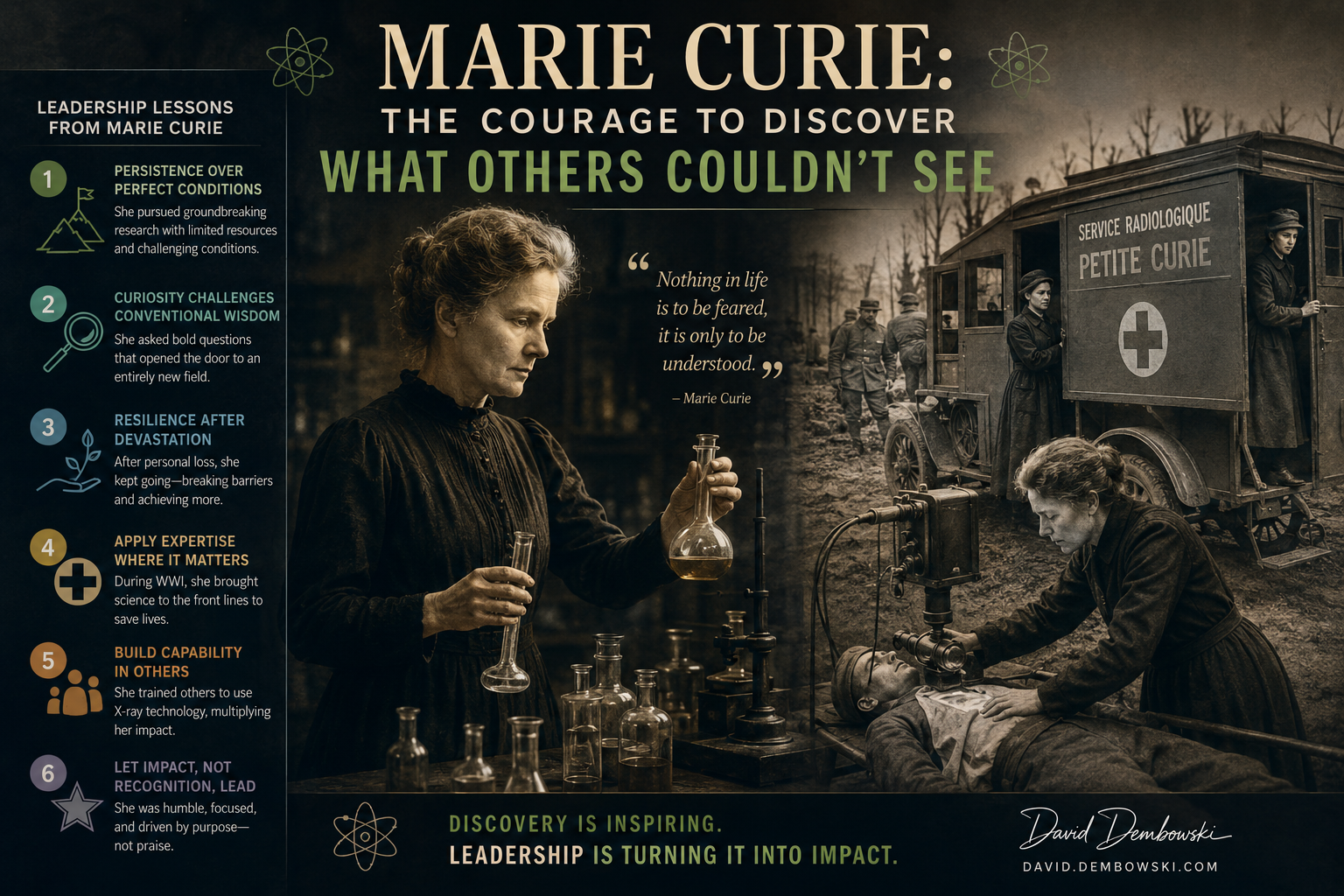
The Courage to Discover
Marie Curie offers a powerful leadership story because her impact went far beyond scientific brilliance. Her life shows persistence, courage, humility, adaptability, and a commitment to putting knowledge to work for others. She became the first woman to hold a professorship at the Sorbonne and remains famous for winning Nobel Prizes in two different sciences.
Leadership Lessons from Marie Curie
1. Persistence Can Matter More Than Resources. Curie and Pierre conducted much of their early research under extremely difficult conditions, with inadequate laboratory facilities while also teaching to support themselves. Yet that work ultimately contributed to the discovery of polonium and radium.
Leadership lesson: Great leaders don't wait for perfect conditions. They make progress with what they have.
2. Let Curiosity Challenge Conventional Wisdom. Curie pursued the mysterious radiation observed in uranium and helped open an entirely new field of scientific inquiry. Her work fundamentally changed our understanding of matter and radioactivity.
Leadership lesson: Breakthroughs often begin with the willingness to ask a question others aren't asking.
3. Resilience Is What Happens After the Setback. Pierre Curie's sudden death in 1906 was devastating. Marie continued their work, succeeded him at the Sorbonne, and became the institution's first female professor. Five years later, she received her second Nobel Prize.
Leadership lesson: Resilience isn't avoiding adversity. It's continuing the mission after adversity changes you.
4. Leadership Means Applying Expertise Where It Matters. During World War I, Curie moved beyond the laboratory. She helped develop mobile X-ray units—eventually equipping more than 20 vehicles and roughly 200 fixed installations—so physicians could locate bullets, shrapnel, and fractures in wounded soldiers. She even drove a radiology vehicle herself and trained others to use the technology.
Leadership lesson: Expertise becomes leadership when you use it to solve a real problem.
5. Build Capability in Others. Curie didn't simply operate the X-ray equipment herself. She trained young women in radiology so the technology could be deployed more broadly.
Leadership lesson: The strongest leaders don't make themselves indispensable. They make other people capable.
6. Recognition Should Follow the Mission—not Become the Mission. Despite extraordinary achievements, the Nobel biography describes Curie as "quiet, dignified and unassuming." Her career remained centered on research, education, and applying science to alleviate suffering.
Leadership lesson: Impact is a better measure of leadership than attention.
The Curie Leadership Principle
Curie's story could be distilled into one idea:
Don't wait for ideal conditions. Pursue what matters, persist when it's difficult, and turn what you know into something that helps others.
