
Leadership Lesson: The Empire State Building - When Ambition Meets Execution
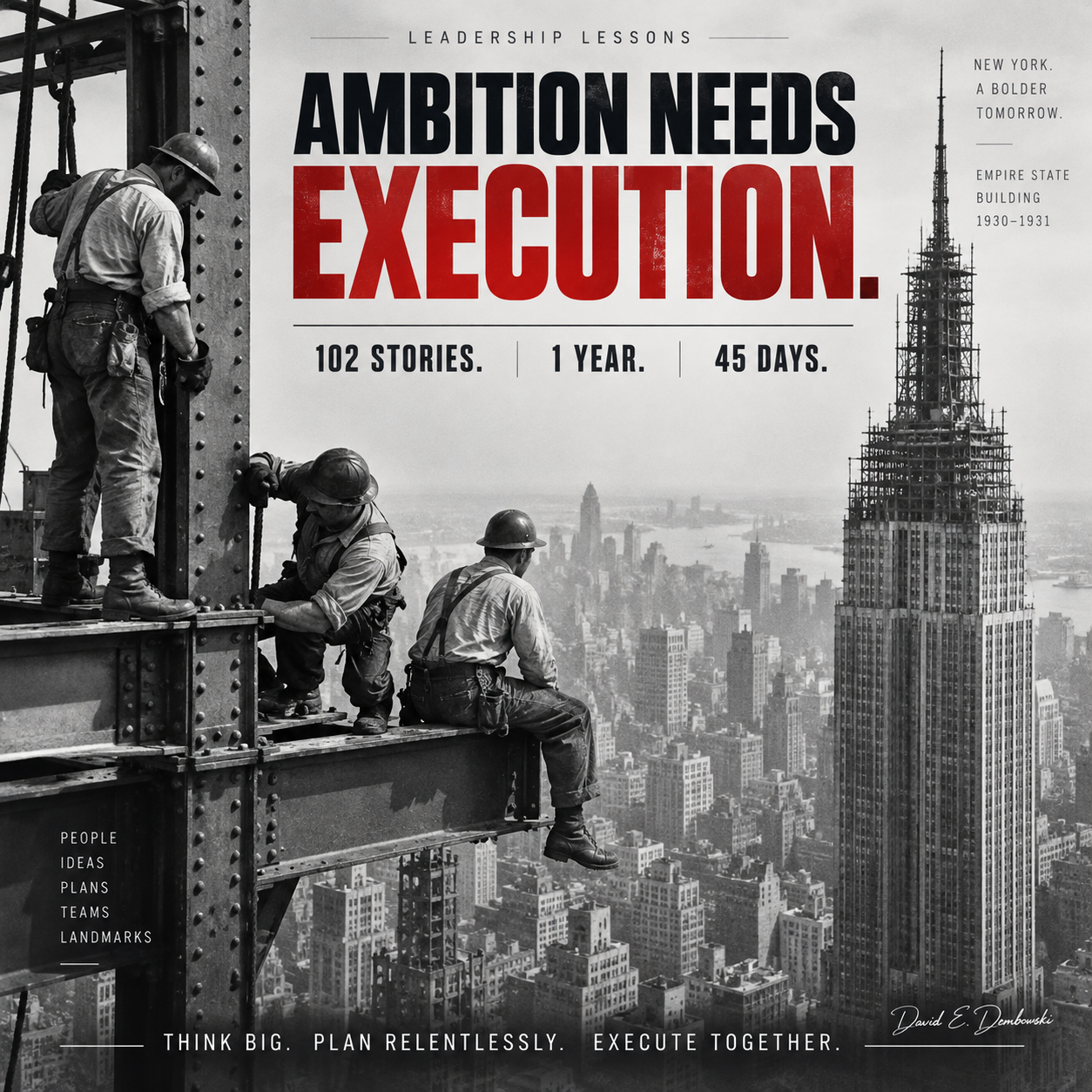
Ambition needs execution
On March 17, 1930, construction began on what many considered an almost impossible undertaking:
Build the tallest building in the world. Not eventually. Fast. Just 1 year and 45 days later, the Empire State Building opened its doors. 102 stories, or approximately 1,250 feet tall. Built during the opening years of the Great Depression and completed at a pace that remains extraordinary nearly a century later. But the real leadership lesson isn't the building's height. It's how they got there.
Start With an Audacious Goal
Financier John J. Raskob and former New York Governor Al Smith drove the vision behind the Empire State Building. New York was in the middle of a skyscraper race. Buildings were climbing higher, engineering was advancing, and the city's skyline was being reinvented. Raskob didn't want another office building. He wanted the tallest building in the world.
That ambition created clarity. Everyone involved understood the objective. Leadership has moments when incremental goals produce incremental thinking. Sometimes a goal needs to be ambitious enough to force the organization to rethink how it gets work done.
Turn Complexity Into a System
The Empire State Building wasn't built quickly because thousands of people worked harder. It was built quickly because the work was orchestrated.
Architects Shreve, Lamb & Harmon designed the building. Starrett Brothers & Eken managed construction.
At peak construction, roughly 3,400 workers could be on the project in a single day.
Steelworkers
Riveters
Electricians
Plumbers
Masons
Carpenters
Elevator installers
Material suppliers
Each depended on the work happening before them.
The project therefore operated like a manufacturing assembly line—except the assembly line moved upward into the Manhattan sky.
Steel components were identified so crews knew where they belonged. Materials were delivered and moved through the building according to the construction sequence. Temporary rail systems helped move supplies across floors.
The steel structure rose at an average pace of roughly 4½ stories per week. That isn't simply speed. That's coordination.
Speed Is Usually a Product of Preparation
We often associate speed with urgency. But sustainable speed comes from something different: Preparation.
The teams building the Empire State Building knew what materials were needed, where they needed to go, who needed them, and what needed to happen next.
Instead of waiting for one stage to finish before beginning another, multiple phases of construction progressed in a carefully coordinated sequence.
The lesson for today's leaders is powerful:
You don't create speed by telling people to move faster.
You create speed by removing what slows them down.
Unclear ownership. Unnecessary approvals. Poor communication. Missing resources. Conflicting priorities. Bad handoffs.
Great operating systems eliminate friction before asking people to do more.
Break the Impossible Into Repeatable Work
Imagine standing on Fifth Avenue in 1930 and being told that a 102-story skyscraper would soon occupy the site.
The goal sounds overwhelming.
But nobody showed up each morning tasked with:
“Build the Empire State Building.”
They had specific jobs.
Set the next steel column. Drive the next rivet. Move the next shipment. Install the next window. Finish the next floor.
Great leaders understand this distinction. Vision creates inspiration. Systems create execution.
The leader's job is to connect the two.
The People Still Matter Most
The famous photographs of workers sitting casually on steel beams hundreds of feet above Manhattan capture something easy to overlook when discussing the building's engineering achievement.
People built it—thousands of them. Many were immigrants, and the workforce included Mohawk ironworkers renowned for their skill working at extraordinary heights.
No spreadsheet, blueprint, or construction schedule could raise the building without skilled teams executing the work. That's another important leadership lesson. Technology changes. Tools improve. Processes become faster.
But extraordinary execution still depends on people who understand their role, trust the people around them, and believe their work contributes to something larger.
Ambition Doesn't Guarantee Immediate Success
Another part of the Empire State Building story makes the leadership lesson even stronger.
The building opened on May 1, 1931 - right into the Great Depression.
Finding tenants was difficult. So much space sat vacant at first that critics nicknamed it the “Empty State Building.”
Think about that.
Some initially considered one of the greatest engineering and construction achievements in American history a commercial disappointment.
Today, it's impossible to imagine the New York skyline without it.
Leadership sometimes requires the conviction to build for a future others can't see yet.
Not every great decision produces immediate validation.
The Leadership Lesson
The Empire State Building demonstrates what can happen when ambition, planning, coordination, and execution align.
Set a goal big enough to inspire people.
Build a system that can deliver it. Give people clear responsibilities. Remove friction. Coordinate relentlessly. And keep everyone focused on what comes next.
Because extraordinary organizations don't accomplish extraordinary things simply because they have extraordinary people.
They create an environment where extraordinary people can execute together.
The Empire State Building took just 1 year and 45 days to build.
Nearly a century later, it still stands above Manhattan as a reminder:
Think big. Plan relentlessly. Execute together. That's how ambitious ideas become landmarks.
Historical Note
The historical backbone here is particularly strong: official Empire State Building records put construction from March 17, 1930, to May 1, 1931, with the 102-story building rising at roughly 4½ stories per week. The Library of Congress notes a workforce approaching 3,400 people, while construction accounts describe the highly coordinated, assembly-line-like logistics that made that pace possible. (Empire State Building).
