
Lee Iacocca: Leadership When the Road Gets Rough
In 1978, Ford Motor Company fired Lee Iacocca.
It was a stunning fall.
Iacocca spent more than three decades at Ford, rose to president, and helped launch one of the most successful cars in American history—the Ford Mustang.
Then Henry Ford II fired him.
For many executives, that might have been the end of the story.
For Iacocca, it was the beginning of the chapter that would define his leadership legacy.
Taking the Wheel at Chrysler
In 1979, Iacocca became Chrysler's CEO.
He wasn't walking into a turnaround. He was walking into a crisis.
Chrysler was losing money, struggling with debt, facing intense foreign competition, and running dangerously short of cash. Bankruptcy was a real possibility.
Iacocca quickly realized incremental change wouldn't save the company.
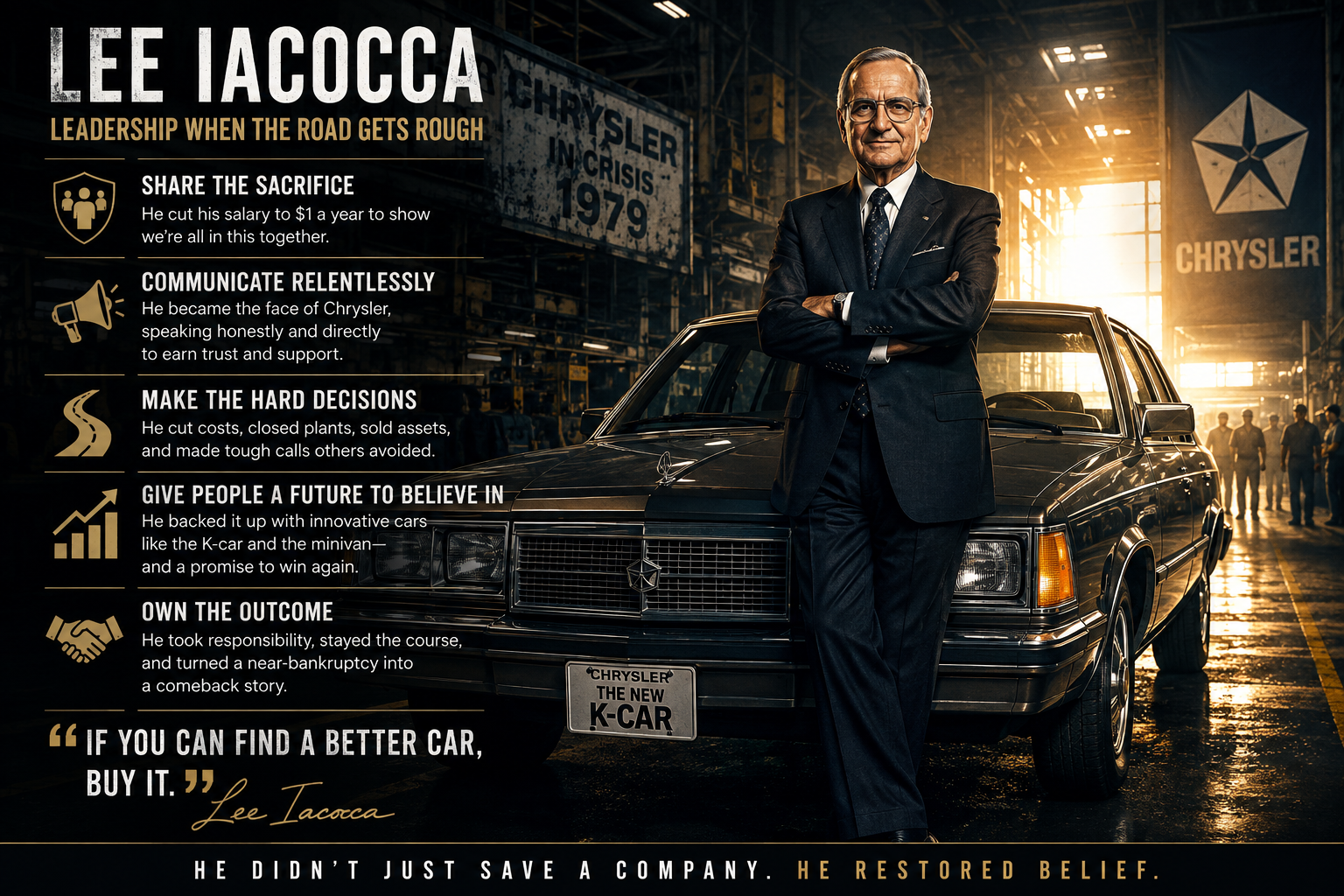
He cut costs. He closed plants. He sold assets. He replaced executives. He renegotiated agreements with suppliers and unions.
And he made perhaps his boldest move: asking the U.S. government to guarantee $1.5 billion in loans.
It was controversial.
But Iacocca didn't simply ask others to sacrifice.
He famously reduced his own salary to $1 a year.
The message was powerful:
We're all in this together.
Leadership Means Selling the Future
Iacocca understood something every leader eventually learns:
When an organization is struggling, spreadsheets alone won't save it.
People need to believe there is a future worth fighting for.
Iacocca became Chrysler's public face. He went on television and spoke directly to consumers, employees, policymakers, and investors.
His famous challenge became:
"If you can find a better car, buy it."
He wasn't hiding behind the corporate brand.
He backed the company with his own credibility.
Chrysler introduced the K-car platform and, later, the minivan—products that helped reshape the company's fortunes. Chrysler ultimately repaid its government-backed loans years early.
The company survived.
And Iacocca became one of America's most recognizable business leaders.
The Leadership Lesson
Iacocca's story isn't simply about saving a car company.
It's about what leaders do when the plan breaks down.
Your setback doesn't define you
Being fired from Ford could have defined Iacocca's career. Instead, he used the experience as fuel for what came next.Leaders share the sacrifice
It's difficult to ask employees to make painful changes if leadership appears insulated from them.In a crisis, communicate constantly
People can handle difficult news better than uncertainty. Iacocca gave people a clear picture of the problem and a reason to believe they could solve it.Make the hard decisions early
Turnarounds rarely happen through small adjustments. Leaders must be willing to confront reality and act.Give people something to believe in
Iacocca wasn't only restructuring Chrysler. He was selling employees, customers, lenders, and the country on the idea that Chrysler could win again.
The Takeaway
Leadership isn't always about taking a successful organization and making it better.
Sometimes leadership means taking the wheel when the engine is failing, the road ahead is uncertain, and everyone is wondering whether the organization will survive.
Great leaders don't deny the crisis.
They confront it, communicate a path forward, share the sacrifice, and give people a reason to keep going.
Lee Iacocca didn't build his leadership legacy when everything was working.
He built it when almost nothing was.
