
A Lesson in Survivorship Bias for Business Leaders
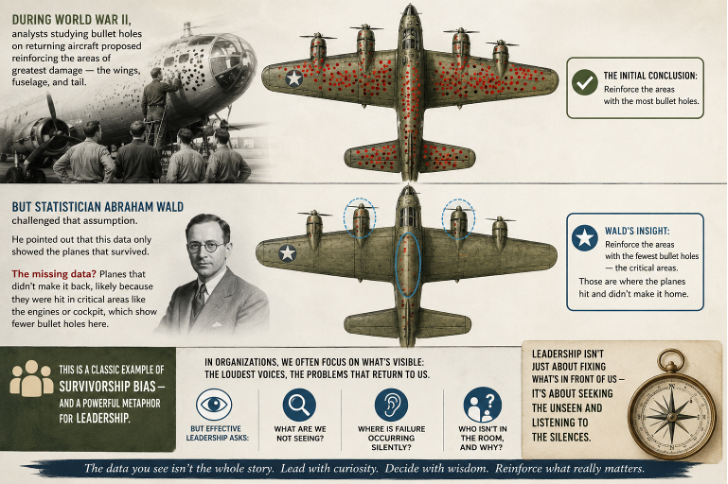
In 1943, the U.S. military faced a practical problem: their aircraft were taking heavy damage, and they needed to decide where to add armor. The solution seemed obvious. Study the planes that came back. Map the bullet holes. Reinforce what was hit.
Then a statistician named Abraham Wald quietly pointed out the flaw.
The planes they were studying were the survivors. The very fact that they returned meant the damage they'd absorbed — to the wings, the fuselage, the tail- wasn't fatal. The truly critical hits, the ones to the engines and cockpit, were invisible in the data. Those planes never made it back to be counted.
Wald's insight was counterintuitive but decisive: Reinforce where the bullet holes aren't. The absence of damage in those spots wasn't evidence of safety — it was evidence of catastrophe.
The data you never collect
Most managers are good at responding to what's in front of them.
The team member who raises concerns. The project that visibly stalls. The customer who complains loudly. These are the returning planes, the problems that survived long enough to reach your desk.
But survivorship bias operates quietly in organizations, too. Consider what never makes it into your field of view:
The employee who stopped speaking up, not because things improved, but because they learned it wasn't worth it.
The idea was never proposed because someone watched a similar idea get dismissed six months ago.
The team that looks fine on paper, while its best person is quietly updating their résumé.
The process nobody questions, because the people who once questioned it have already left.
These are your engine hits. And they don't show up in your one-on-ones, your dashboards, or your exit surveys — at least not directly.
