
The Day the World Changed in 19 Moves
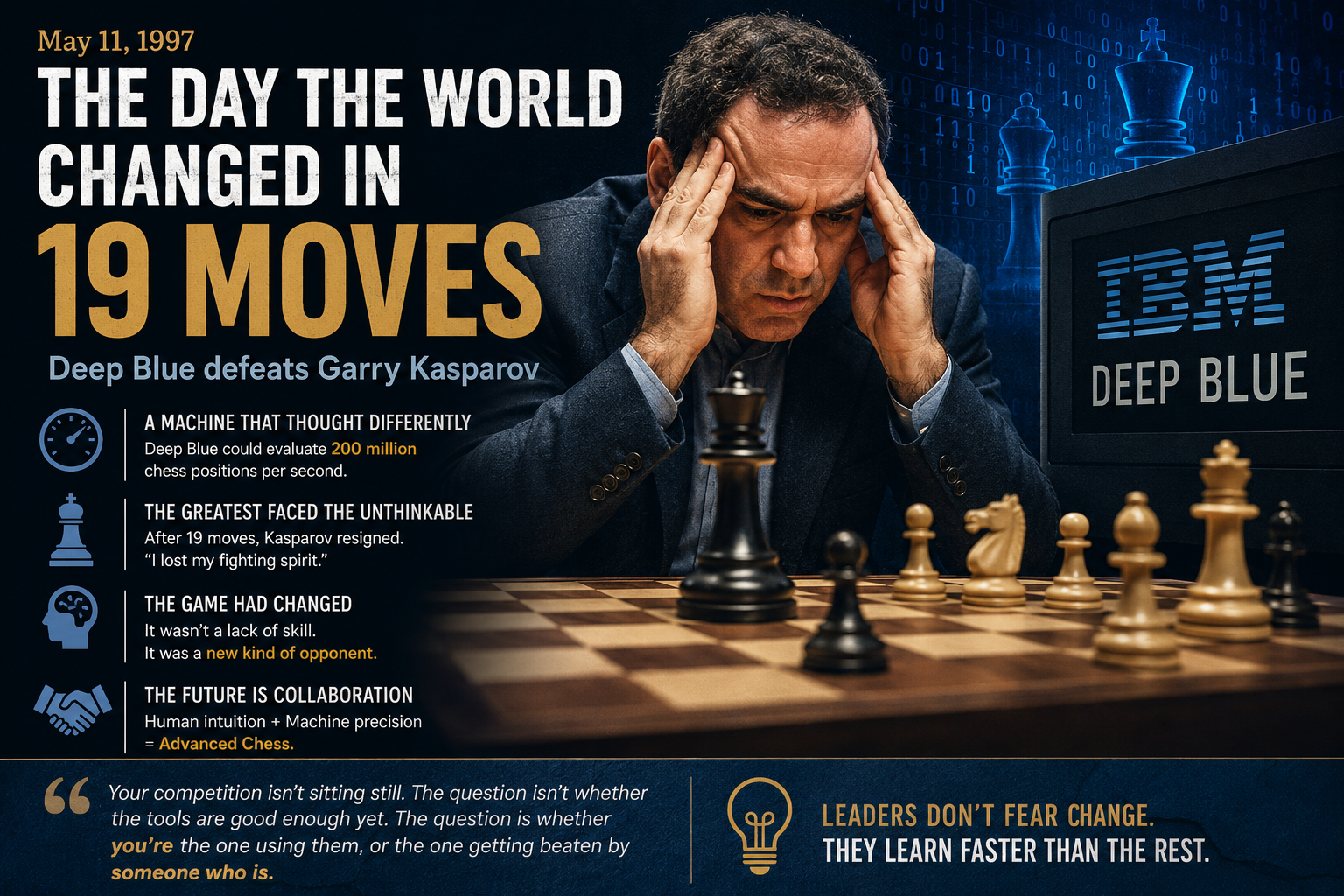
On May 11, 1997, something happened that extended far beyond the world of chess.
The greatest player of his generation—arguably the greatest ever—sat across from a machine in New York City.
Garry Kasparov had dominated the chess world for more than a decade. He was a 12-time World Champion, possessed the highest rating the game had ever seen, and had defeated every human challenger who sat across from him.
Then he faced IBM's Deep Blue.
The computer could evaluate approximately 200 million chess positions every second. Kasparov couldn't. No human could.
Game 6 lasted barely an hour.
After just 19 moves, Kasparov did something almost unimaginable.
He resigned.
Later he reflected, "I lost my fighting spirit."
Most people remember this as the day artificial intelligence defeated humanity.
It marked something much more important.
It was the day we learned that the best in the world can still be using the wrong approach.
Kasparov wasn't unprepared.
He wasn't unintelligent.
He wasn't complacent.
He was trying to outthink something that operated by an entirely different set of strengths—faster, deeper, tireless, and without emotion.
Even many grandmasters watching the match believed his position was still defensible. Fellow grandmaster John Fedorowicz famously remarked that the position "didn't seem lost."
Kasparov saw something they didn't.
The game itself had changed.
The Leadership Lesson
Every generation of leaders eventually encounters its own version of Deep Blue.
Sometimes it's a new technology.
Sometimes it's a new business model.
Sometimes it's an entirely different way of making decisions.
History rarely rewards the people who insist on playing yesterday's game better than everyone else.
It rewards those who recognize that the rules have changed.
Today, AI represents that inflection point for nearly every profession. The question isn't whether the technology is perfect. The question is whether your competitors are learning to use it while you're still debating whether it matters. The organizations creating the greatest advantage aren't replacing human judgment. They're amplifying it.
Kasparov's Greatest Victory Came After His Defeat
Ironically, Kasparov's most important contribution may not have been his world championships.
It came after he lost.
Rather than rejecting technology, he embraced collaboration between humans and machines. He championed what became known as Advanced Chess, in which humans partnered with computers rather than competing against them.
His conclusion was profound:
Human intuition combined with machine precision consistently outperformed either one alone.
That's a lesson every executive should remember.
The future doesn't belong to AI.
It doesn't belong solely to humans either.
It belongs to leaders who know how to combine the strengths of both.
