
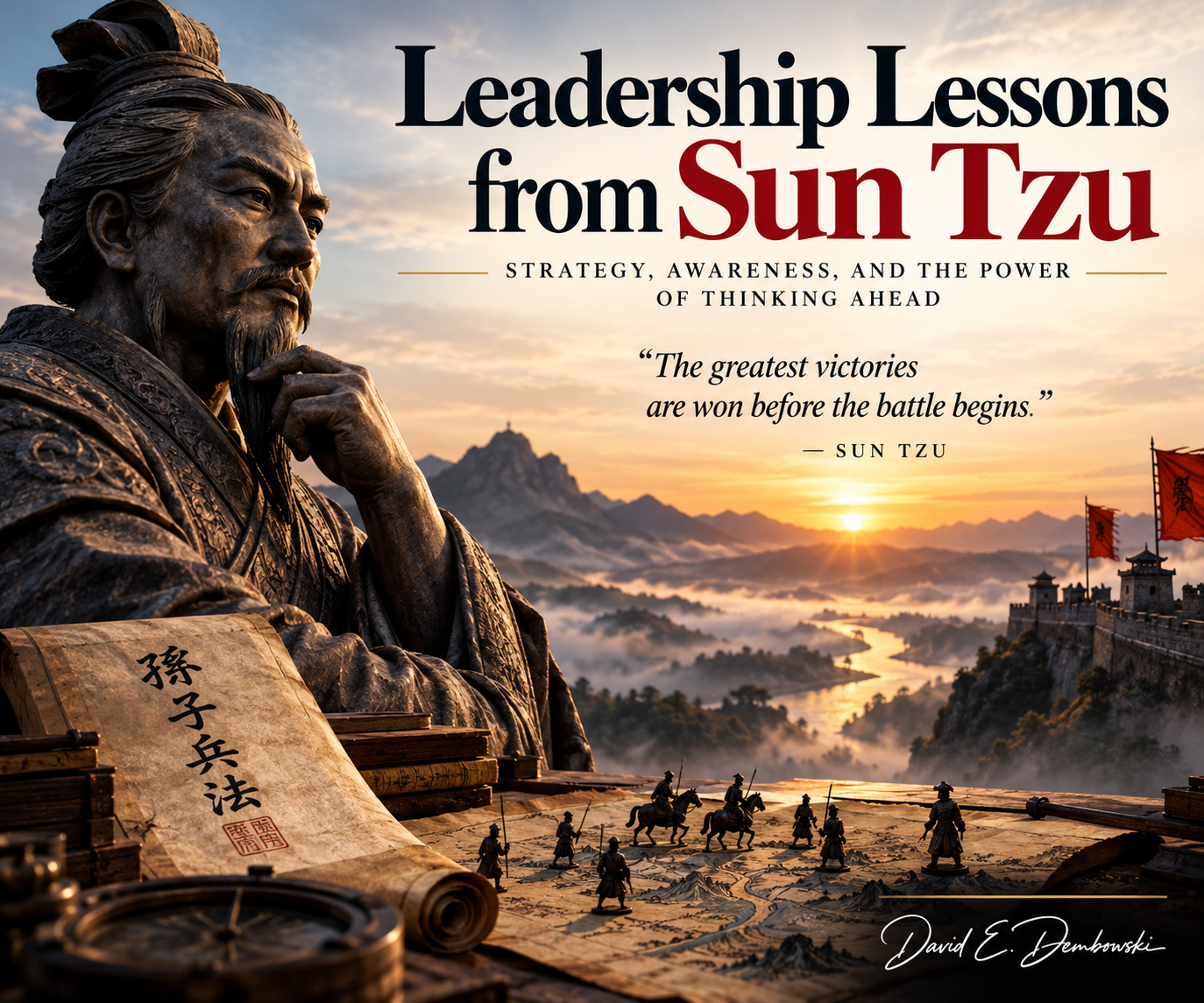
"The supreme art of war is to subdue the enemy without fighting.” - Sun Tzu
Sun Tzu and the Power of Strategic Leadership
More than 2,000 years ago, an ancient Chinese military strategist named Sun Tzu developed a philosophy of warfare that would influence generations of military commanders, political leaders, and business strategists. His work, The Art of War, challenged a fundamental assumption about conflict: that victory belonged to the side with the largest army, the greatest resources, or the most aggressive commander.
Sun Tzu believed otherwise. He argued that the greatest commanders did not simply defeat their enemies through force. They created the conditions for victory long before the battle began. They studied the terrain, understood their opponents, assessed their own capabilities, and recognized when circumstances favored action—and when restraint was the wiser choice. One of his most enduring principles was that the highest form of military excellence was to overcome an opponent without fighting. For Sun Tzu, strategy was not simply about winning battles. It was about making unnecessary battles irrelevant.
The Leadership Lesson
Modern business leaders operate in environments defined by competition, limited resources, technological disruption, and constant pressure to deliver results. The instinct is often to respond with more activity. More investment. More products. More initiatives. More meetings. More aggressive targets.
But activity isn't strategy, and effort alone doesn't guarantee progress. Sun Tzu's philosophy offers a different perspective. The most effective leaders don't try to win everywhere. They understand where their organizations have meaningful advantages, where resources can generate the greatest returns, and where differentiation can avoid competition.
Execution determines how effectively we compete. Strategy determines whether we are competing in the right place. This distinction matters even more in today's rapidly changing business environment. Organizations can execute flawlessly against a strategy that is no longer relevant. Sometimes the most valuable leadership decision isn't what to pursue, but what to stop pursuing.
Three Lessons for Leaders
1. Choose your battles deliberately. Every organization operates with finite resources: capital, talent, time, and leadership attention. Yet many companies spread those resources across too many priorities, markets, products, and initiatives. Sun Tzu understood that strength comes from concentration, not dispersion. Great leaders identify the opportunities where their organizations can create a meaningful advantage and have the discipline to say no to those that cannot.
Strategy is as much about what you choose not to do as what you choose to pursue.
2. Preparation creates competitive advantage. Sun Tzu emphasized the importance of understanding both one's own capabilities and those of an opponent. In business, this means understanding customers, competitors, market dynamics, organizational strengths, and emerging threats before making consequential decisions. The best leaders do not confuse decisiveness with impulsiveness. They build organizations that anticipate change rather than merely react to it.
Preparation does not eliminate uncertainty. It improves the quality of decisions made within it.
3. The greatest victories don't always look like battles. In business, competitive success is often measured through market share gains, customer acquisitions, product launches, and deals won against rivals. But some of the most valuable victories come from changing the competitive equation altogether.
A differentiated product can make price competition less relevant.
A superior customer experience can reduce the need for aggressive selling.
A strategic partnership can create opportunities that direct competition cannot.
A more efficient operating model can deliver advantages competitors struggle to replicate. Great leaders recognize that sustainable success is not always about defeating competitors.
Sometimes it is about creating value in ways competitors cannot easily challenge.
The Takeaway
Sun Tzu's philosophy reminds us that leadership requires more than courage, ambition, and execution. It requires judgment. The judgment to know when to act, when to wait, where to invest, and what to abandon. In an era of artificial intelligence, rapidly evolving business models, and increasingly complex markets, the temptation is to compete on every front. But the strongest organizations rarely do the most. They understand where they can create the greatest advantage and align their resources accordingly.
Great leaders don't win by fighting every battle. They win by making sure the battles they choose are worth fighting.
