
Leadership Principles
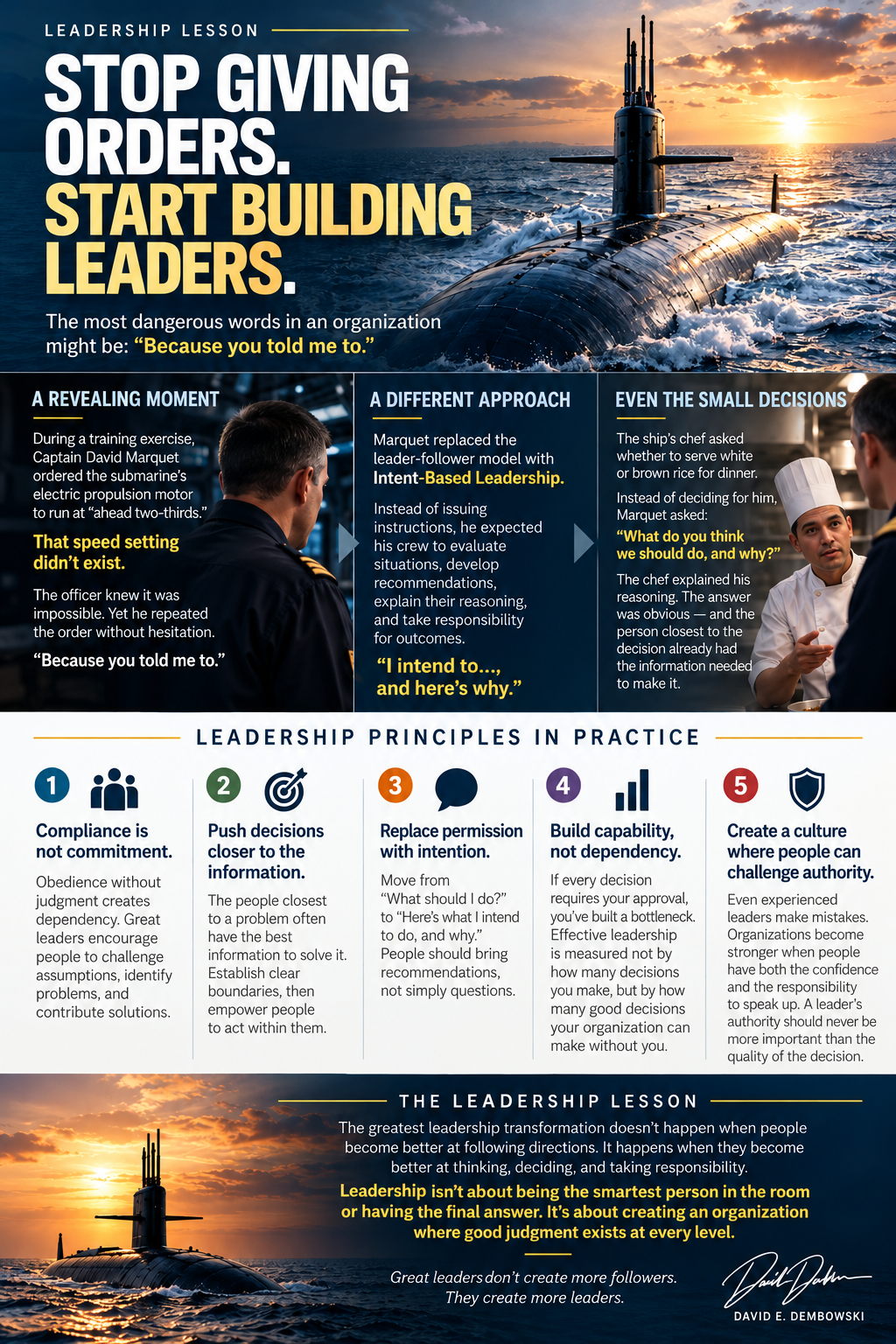
The most dangerous words in an organization might be: "Because you told me to."
When Captain L. David Marquet took command of the USS Santa Fe, a nuclear-powered submarine, in 1999, he inherited one of the lowest-performing crews in the U.S. Navy. The problem wasn't a lack of talent or experience. It was a culture built around obedience rather than ownership.
During a training exercise, Marquet ordered the submarine's electric propulsion motor to run at "ahead two-thirds." There was just one problem. That speed setting didn't exist on the USS Santa Fe. The officer responsible for carrying out the order knew it was impossible. Yet instead of challenging the captain, he repeated the order.
When Marquet questioned him, the explanation was simple: the captain had given the instruction. The incident revealed something far more troubling than a misunderstood command. The crew had been conditioned to follow orders, even when they knew those orders were wrong.
Marquet recognized that the traditional leader-follower model created dependency, discouraged independent thinking, and concentrated decision-making authority at the top. And he realized something even more important: as captain, he was reinforcing the very behavior he needed to change. So he fundamentally changed his leadership approach.
Instead of issuing instructions and expecting compliance, Marquet introduced Intent-Based Leadership. Crew members were encouraged to replace "What should I do?" with "I intend to..." Rather than waiting for permission or direction, they were expected to evaluate situations, develop recommendations, explain their reasoning, and take responsibility for outcomes.
The captain's role shifted from providing answers to developing judgment.
In one account of life aboard the submarine, even the ship's chef approached Marquet with a routine question: Should dinner include white rice or brown rice? Instead of deciding, Marquet asked what the chef thought and why. The chef explained that the crew preferred white rice, more was in inventory, and it complemented the meal. The answer was obvious. More importantly, the person closest to the decision already had the information needed to make it. The transformation was remarkable.
Under Marquet's leadership, the USS Santa Fe became one of the Navy's highest-performing submarines, earning recognition for operational excellence and developing future submarine commanders.
A new technology, a larger budget, or a different crew didn't drive the turnaround. A different leadership approach drove it.
Leadership Principles in Practice
1. Compliance is not commitment.
An organization where everyone follows instructions may appear disciplined, but obedience without judgment creates dependency. Great leaders encourage people to challenge assumptions, identify problems, and contribute solutions. The objective isn't simply execution. It's informed execution.
2. Push decisions closer to the information.
The people closest to a problem often have the best information to solve it. When every decision travels up the organizational hierarchy, speed declines, accountability weakens, and leadership becomes a bottleneck. Establish clear boundaries, then empower people to act within them.
3. Replace permission with intention.
"What should I do?" differs fundamentally from "Here's what I intend to do, and why."
The first transfers responsibility upward. The second demonstrates preparation, independent thinking, and ownership. Leaders should develop people who bring recommendations, not simply questions.
4. Build capability, not dependency.
If every decision requires your approval, you haven't built a scalable organization. You've built a bottleneck.
Effective leadership is measured not by how many decisions you make, but by how many good decisions your organization can make without you.
5. Create a culture where people can challenge authority.
Perhaps the most important lesson from the USS Santa Fe is that even experienced leaders make mistakes. Organizations become stronger when employees have both the confidence and the responsibility to speak up.
A leader's authority should never be more important than the quality of the decision.
The Leadership Lesson
The greatest leadership transformation doesn't happen when people become better at following directions. It happens when they become better at thinking, deciding, and taking responsibility.
Leadership isn't about being the smartest person in the room or having the final answer. It's about creating an organization where good judgment exists at every level.
Great leaders don't create more followers. They create more leaders.
