
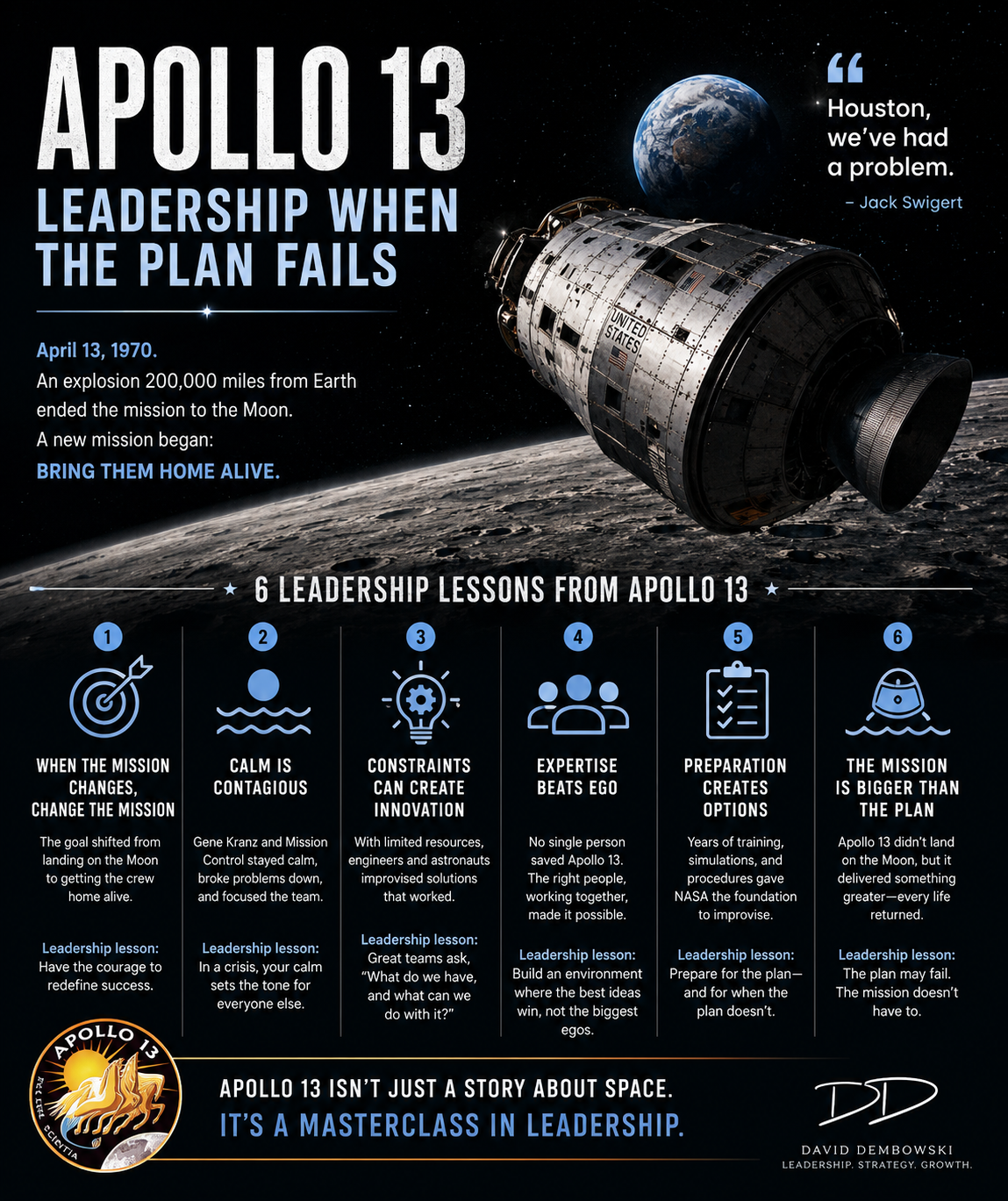
April 13, 1970.
More than 200,000 miles from Earth, an oxygen tank exploded aboard Apollo 13.
The mission had been simple: land two astronauts on the Moon and bring the crew safely home.
In an instant, that mission disappeared.
Astronaut Jack Swigert radioed Mission Control:
“Houston, we’ve had a problem.”
What followed became one of history’s greatest examples of leadership under pressure.
NASA had spent years preparing Apollo 13 to go to the Moon. Nobody had a playbook for bringing a crippled spacecraft home from deep space.
Yet that is exactly what they did.
1. When the Mission Changes, Change the Mission
The lunar landing was immediately abandoned.
Success was no longer walking on the Moon.
Success was getting Jim Lovell, Jack Swigert, and Fred Haise home alive.
Great leaders recognize when circumstances have fundamentally changed. They don't waste time defending yesterday's objective simply because they invested heavily in it.
Leadership lesson: When reality changes, dare to redefine success.
2. Calm Is Contagious
On the ground, Flight Director Gene Kranz and Mission Control faced an extraordinary situation: falling oxygen levels, limited electrical power, rising carbon dioxide, uncertain navigation, and a spacecraft never designed to operate this way.
Panic would solve none of it.
The teams broke an overwhelming problem into smaller problems they could solve.
Power.
Oxygen.
Navigation.
Carbon dioxide.
Trajectory.
One problem at a time.
Leadership lesson: In a crisis, your team takes emotional cues from its leaders. Calm doesn't mean the situation isn't serious. It means the problem is more important than the panic.
3. Constraints Can Create Innovation
One of Apollo 13's most famous problems involved rising carbon dioxide levels.
The command module had square lithium-hydroxide canisters. The lunar module used round openings.
The astronauts needed to make one fit the other.
Engineers on Earth gathered materials available aboard the spacecraft and devised a makeshift adapter using items including plastic bags, cardboard, a hose, and duct tape. Mission Control then talked the astronauts through building it in space.
It wasn't elegant.
It worked.
Leadership lesson: Great teams don't wait for perfect resources. They ask, What do we have, and what can we do with it?
4. Expertise Beats Ego
No single person saved Apollo 13.
Astronauts, flight controllers, engineers, contractors, mathematicians, and countless specialists worked the problem together.
Leadership wasn't about having all the answers.
It was about getting the right people focused on the right problems—and trusting them to solve them.
Leadership lesson: The best leader in the room isn't necessarily the person with the answer. It's often the person who creates the environment where the answer can emerge.
5. Preparation Creates Options
Apollo 13 is often remembered as an incredible improvisation.
It was.
But improvisation alone didn't bring those astronauts home.
Years of training, simulations, procedures, technical knowledge, and teamwork gave NASA the foundation it needed to improvise when the unexpected happened.
They could break the rules because they understood the system.
Leadership lesson: You don't prepare because everything will go according to plan. You prepare so you're ready when it doesn't.
The Bigger Leadership Lesson
On April 17, 1970, Apollo 13 splashed down safely in the Pacific Ocean.
The mission never landed on the Moon.
By its original objective, Apollo 13 failed.
By another measure, it became one of NASA's greatest achievements.
That's what makes Apollo 13 such a powerful leadership story.
Leadership is relatively easy when the strategy works, the forecast holds, the technology performs, and the organization follows the plan.
The real test comes when the assumptions collapse.
When the destination is no longer reachable.
When the resources you thought you had disappear.
When there is no playbook.
That's when leadership becomes less about executing the plan and more about creating clarity, maintaining confidence, mobilizing expertise, and finding a new path forward.
The plan may fail.
The mission doesn't have to.
