
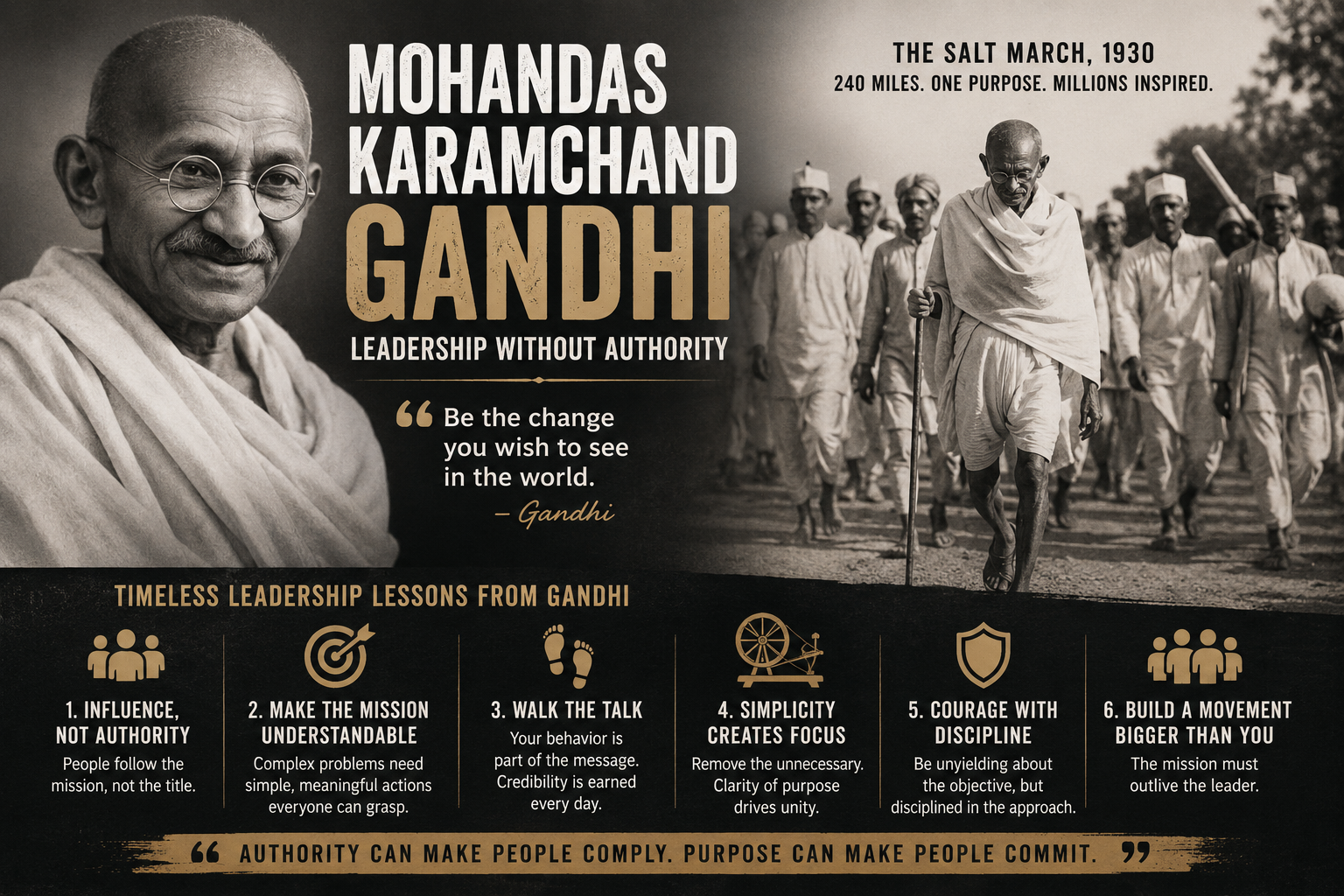
Mahatma Gandhi never commanded an army, ran a corporation, or held the highest office of a nation.
Yet he helped mobilize millions and fundamentally altered the course of history.
His leadership came from something harder to manufacture than authority: credibility, discipline, purpose, and the ability to persuade people to act together.
1. Influence can be more powerful than authority
Gandhi couldn't order millions of Indians to follow him. They had to choose to follow.
That distinction matters for any leader. A title can give you compliance. It cannot guarantee commitment.
The strongest leaders eventually reach the point where people follow the mission—not simply the person giving the orders.
2. Make the mission understandable
One of Gandhi's greatest talents was turning enormous political issues into actions ordinary people could understand.
The 1930 Salt March is a remarkable example.
British colonial laws restricted Indians’ ability to produce salt and taxed it. Gandhi walked roughly 240 miles to the Arabian Sea, where he symbolically made salt in defiance of British law.
Salt was simple. Everyone needed it.
A complicated political struggle suddenly had a symbol everyone could understand.
Leadership lesson: If people can't explain your strategy, they probably can't execute it.
3 Your behavior becomes part of the message
Gandhi's philosophy of satyagraha emphasized nonviolent resistance grounded in truth and moral conviction.
That required extraordinary discipline.
If Gandhi preached restraint while behaving recklessly, the movement's credibility would have collapsed.
Leaders face the same test.
People watch what leaders do far more closely than what leaders put on PowerPoint slides, write in company values, or say at town halls.
4. Simplicity creates focus
Gandhi deliberately embraced a simple lifestyle and used recognizable symbols such as homespun khadi clothing and the spinning wheel.
These weren't merely aesthetic choices. They reinforced ideas of self-reliance and resistance to economic dependence on British-produced goods.
Great leaders constantly ask:
What can we remove so everyone understands what matters most?
5. Courage doesn't require aggression
Gandhi demonstrated a different form of strength.
Nonviolence wasn't passive. It required participants to accept enormous personal risk while maintaining discipline.
That distinction matters in leadership.
You can be unyielding about the objective while remaining disciplined about how you pursue it.
The loudest person in the room isn't necessarily the strongest leader.
6. Build a movement bigger than yourself
Perhaps the most enduring leadership lesson is that Gandhi wasn't trying merely to win individual confrontations.
He helped create a movement that could continue through setbacks, imprisonment, violence, disagreement, and changing political circumstances.
That is the difference between leadership and personal influence.
Personal influence asks:
"Will people follow me?"
Leadership asks:
"Will people continue pursuing the mission when I'm no longer in the room?"
The Leadership Lesson
Authority can make people comply. Purpose can make people commit.
Gandhi's legacy is complex, and aspects of his views and conduct, particularly some of his earlier writings about Africans and elements of his personal life, remain subjects of legitimate historical criticism. A leadership lesson shouldn't require turning its subject into a flawless hero.
The more useful lesson is narrower:
Gandhi demonstrated that a leader with no conventional source of power can mobilize enormous numbers of people by combining a clear purpose, simple message, personal discipline, and consistent action.
“You don't need authority to lead. You need people willing to follow.” - David Dembowski
