
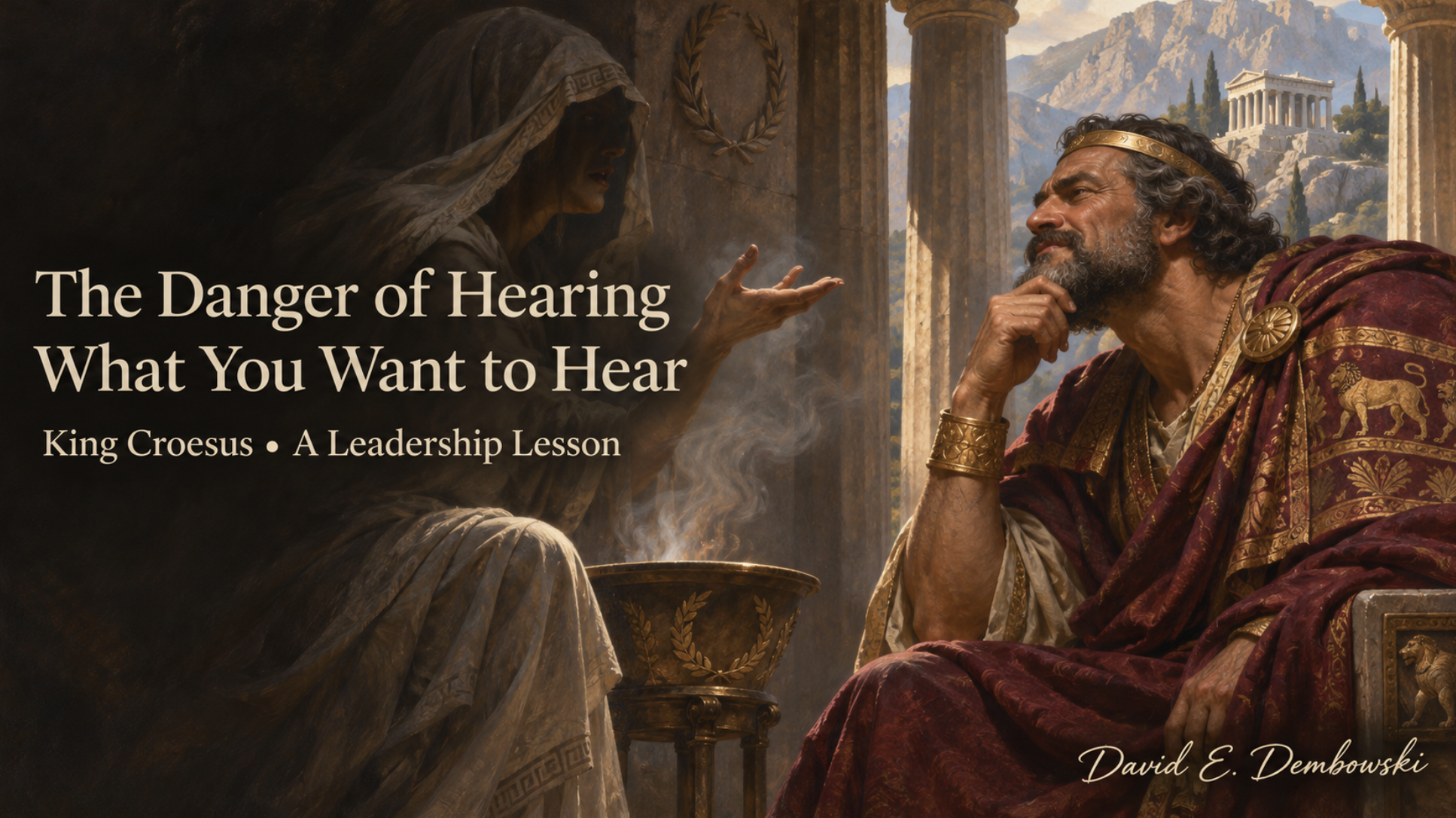
King Croesus heard a prophecy of victory. He never asked whose empire would fall.
King Croesus: The Discipline to Challenge Your Own Assumptions
Success can make a leader's assumptions feel like facts. Resources reinforce confidence. Past victories create expectations. Advice that supports the next ambitious move becomes easier to accept. The story of King Croesus offers an enduring warning about what happens when conviction outpaces understanding.
According to Herodotus, Croesus, king of Lydia, consulted the Oracle at Delphi before going to war against Persia. The response suggested that his campaign would destroy a great empire. Croesus interpreted this as a prediction of victory. He proceeded. The empire destroyed was his own. The account belongs to an ancient storytelling tradition, but its leadership lesson remains useful.
Before acting on an answer you like, examine the assumption that makes it reassuring.
Ask the question your confidence wants to skip
Croesus heard a favorable outcome in an ambiguous answer. The unanswered question was simple: Whose empire? Leaders encounter their own versions of this ambiguity. A growing pipeline can suggest momentum while concealing weak qualification. Strong customer interest can encourage investment before anyone has demonstrated willingness to pay. A successful pilot can create confidence before the organization understands the cost of scaling. The discipline is to pause when an encouraging signal becomes a confident conclusion.
What does the evidence establish? What are we adding through interpretation? What else could explain the result?
Give people room to challenge your interpretation
A leader's confidence shapes what others feel comfortable saying. Once the person in charge announces a strategy will work, disagreement can feel like disloyalty. That makes the leader responsible for inviting scrutiny while there is still time to change the decision. Before a major commitment, ask someone to build the strongest case against it. Invite the team closest to execution to identify the weakest assumption. Thank people who surface inconvenient evidence, and show how their input affects the plan.
People learn whether challenge is welcome by watching what happens to the person who challenges you.
Define what would change your mind
It is easy to claim that a strategy is driven by evidence. The harder test is identifying, in advance, what evidence would cause you to reconsider.
Before committing, establish:
Which assumptions must hold for the strategy to succeed.
What early results would indicate those assumptions are wrong.
When you will review progress and adjust the commitment.
This gives the organization a way to respond before a disappointing outcome becomes expensive.
