
When the Mine Failed, the Company Found Gold: The Innovation Lesson of 3M
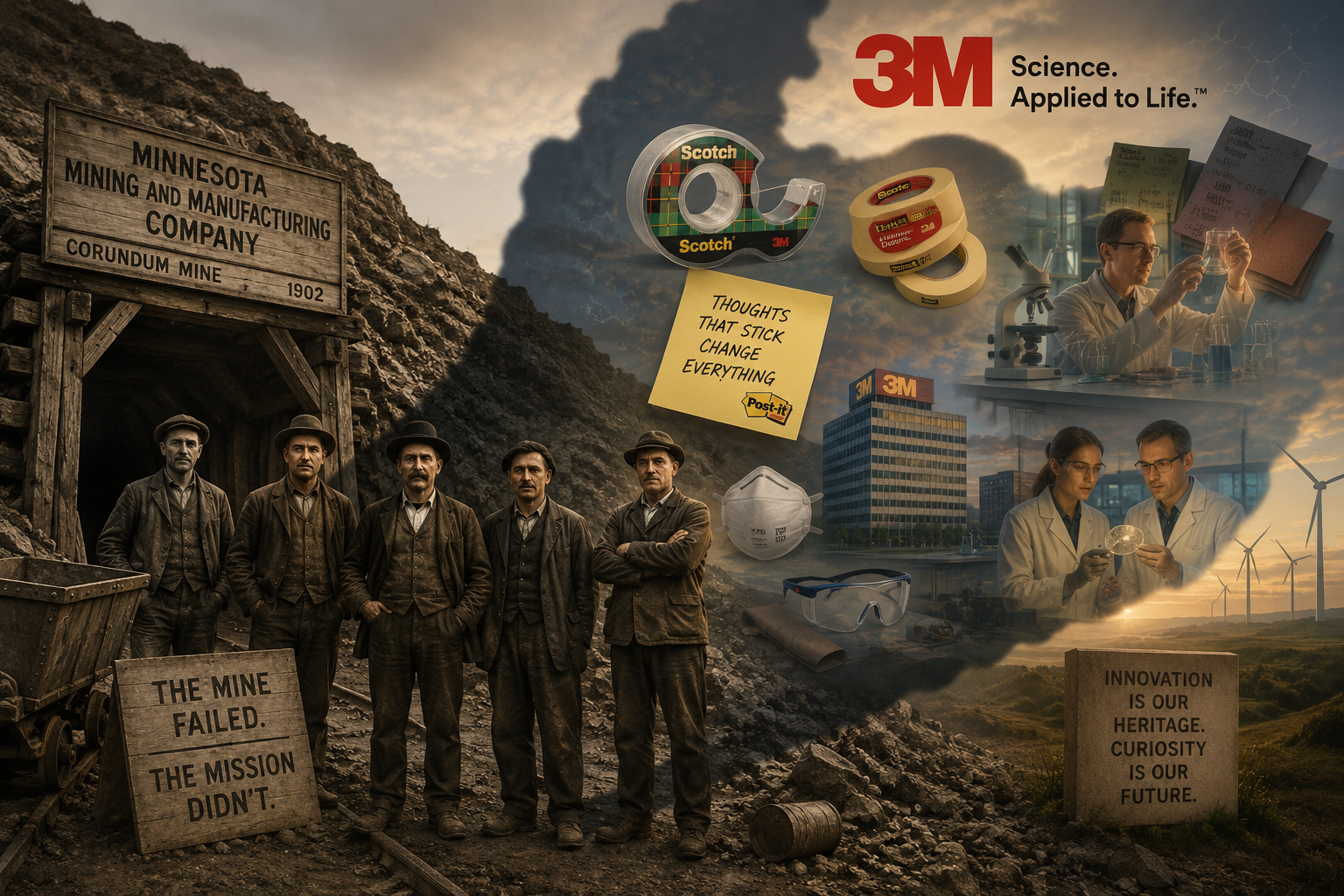
A mistake became a multibillion-dollar product.
“The essence of strategy is choosing what not to do.”- Michael Porter
In 1902, five businessmen in Two Harbors, Minnesota, had what seemed like a promising idea. They founded the Minnesota Mining and Manufacturing Company - better known today as 3M. The plan was straightforward: mine a mineral called corundum and sell it to manufacturers who needed abrasive materials for grinding wheels.
There was only one problem. The mine was a failure.
The founders soon discovered that the mineral deposit they purchased was not high-quality corundum at all. It was a lower-value rock called anorthosite.
Their core product was gone before the company really started. For many companies, that would have been the end of the story. But 3M did something different.
They adapted.
Instead of abandoning the business, they shifted from mining raw materials to manufacturing products. They learned how to make sandpaper. They focused on solving customer problems. They experimented, improved, and kept moving.
The failed mining company became a learning company. That mindset eventually became 3M’s greatest competitive advantage.
In the 1920s, employee Richard Drew visited an auto body shop and noticed workers struggling to paint two-tone automobiles. Paint lines were messy, and existing solutions were frustrating.
Instead of accepting the problem, Drew experimented.
The result was masking tape.
A few years later, 3M introduced Scotch Tape, creating an entirely new product category.
Decades later, another “failure” created one of the company’s most famous inventions.
In 1968, scientist Spencer Silver was attempting to develop a powerful adhesive. Instead, he created a weak adhesive that could stick, peel away, and stick again. It was technically a failed experiment, and for years, nobody knew what to do with it.
Then another 3M employee, Art Fry, realized it could solve a simple problem: keeping bookmarks from falling out of his church hymnal.
The Post-it Note was born.
A mistake became a multibillion-dollar product.
The company that started with a failed mine built a culture where failed experiments became discoveries.
The leadership lesson from 3M is powerful:
Innovation rarely travels in a straight line.
Great companies are not the ones that never make mistakes. They are the ones that recognize when a mistake is pointing them toward a better opportunity.
3M didn’t find value in the mine.
They found something more valuable: A culture of curiosity, resilience, and reinvention.
