
The Most Ridiculed Idea in Television Became the Future of News
"People who say it cannot be done should not interrupt those who are doing it."— Ted Turner
On June 1, 1980, a bold experiment quietly went live.
From Atlanta, a new network called CNN signed on with its first story: the attempted assassination of civil rights leader Vernon Jordan.
At the time, the launch was viewed by many as a curiosity—if not an outright failure waiting to happen.
The skepticism wasn't irrational.
Cable television was still in its infancy. Only about 23% of American households had cable service. Nearly three out of every four homes couldn't even receive CNN.
The established television business belonged to ABC, CBS, and NBC. News aired at fixed times each day. Viewers watched when the networks decided it was time.
The prevailing wisdom was simple:
No one wanted 24-hour news because no one could watch 24-hour news.
Ted Turner saw something different.
He wasn't building for the existing market.
He was building for the market he believed would exist.
That distinction separates many of history's greatest innovators from everyone else. Visionaries don't simply respond to demand—they often create it.
Betting on the Future
Turner's gamble wasn't just about launching another television network.
He was simultaneously betting on four enormous shifts:
Continuous, 24-hour news
Satellite distribution
Mass adoption of cable television
Consumers' growing desire for information the moment it happened
Every one of those assumptions looked risky in 1980.
Together, they looked impossible.
The early years were painful. CNN lost money. Critics mocked it as the "Chicken Noodle Network." Industry experts dismissed the concept as financially unsustainable.
Turner kept investing anyway.
He expanded international bureaus, hired journalists around the world, and continued building infrastructure long before the business model made economic sense.
He understood something many leaders struggle with:
Markets rarely reward vision immediately.
The Moment Everything Changed
Then came January 1991.
When the Gulf War began, CNN was already positioned around the globe.
While traditional broadcasters raced to assemble coverage for their scheduled evening broadcasts, CNN delivered events live, minute by minute, to viewers around the world.
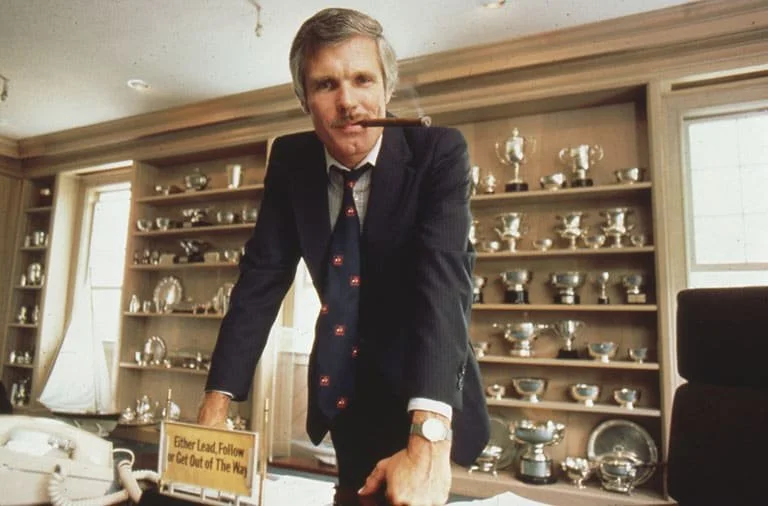
Almost overnight, what had been dismissed as an impossible idea became the future of television news.
The market hadn't suddenly changed.
CNN had simply been preparing for it long before everyone else recognized the opportunity.
Vision Beyond CNN
CNN was hardly Turner's only unconventional bet.
Before cable television became mainstream, he transformed Atlanta's WTBS into America's first "Superstation" by using satellite distribution to reach audiences nationwide.
He built Turner Broadcasting into one of the most influential media companies of the twentieth century, creating or growing iconic brands including CNN, TBS, TNT, Cartoon Network, and Turner Classic Movies.
His vision extended well beyond television.
He revolutionized sports broadcasting through ownership of the Atlanta Braves and Atlanta Hawks, helping demonstrate how sports franchises and media companies could create value together decades before vertical integration became common.
In 1977, he skippered the yacht Courageous to victory in the America's Cup, defeating Australia in a four-race sweep off Newport, Rhode Island.
Later, he pledged $1 billion to establish the United Nations Foundation—one of the largest philanthropic gifts ever made at the time—reflecting his belief that leadership carried responsibilities beyond business.
In 1996, Turner sold Turner Broadcasting to Time Warner in a transaction valued at approximately $7.5 billion, cementing one of the most influential media companies ever built.
Ted Turner passed away on May 6, 2026, at the age of 87.
His legacy extends far beyond the companies he created.
The Leadership Lesson
Many transformational ideas appear unreasonable when viewed through the lens of today's market.
Leaders often ask:
"Is there demand?"
Visionaries ask a different question:
"Will there be demand if we build the future first?"
Innovation isn't simply recognizing trends.
It's recognizing them before they become obvious.
As Turner once said:
"Before you can be a leader, success is all about growing yourself. When you become a leader, success is all about growing others."
Great leaders don't wait for certainty.
They invest before consensus forms.
They build before the market fully exists.
They see around corners while everyone else is focused on the road directly ahead.
That's why the story of CNN remains one of the greatest examples of strategic vision in modern business.
The lesson isn't about television.
It's about leadership.
The organizations that define the next decade will likely look unreasonable today.
The question for every executive isn't whether the future is obvious.
It's whether you're willing to build for it before everyone else does.
