
Building Bridges
The Brooklyn Bridge Is a Masterclass in Resilience
For nearly one hundred and fifty years, the Brooklyn Bridge has granted passage from Brooklyn to Lower Manhattan; an icon of the city’s skyline, however, it’s a miracle the thing was ever built at all.
By 1870, when construction began, Brooklyn was the third-largest city in the United States, home to nearly 400,000 residents and separated from Manhattan by only the East River. Ferries were the lone connection. Winters were brutal, crossings were unreliable, and both cities were rapidly outgrowing the limits of that system. A bridge wasn’t just ambitious; it was necessary.
But from the start, the project was mired in controversy. Shipbuilders and merchants filed lawsuits, claiming the bridge wouldn’t leave enough clearance for tall-masted vessels. Tammany Hall-linked interests hovered around the financing and construction. And many engineers dismissed the design itself as a reckless experiment.
Then came the tragedies.
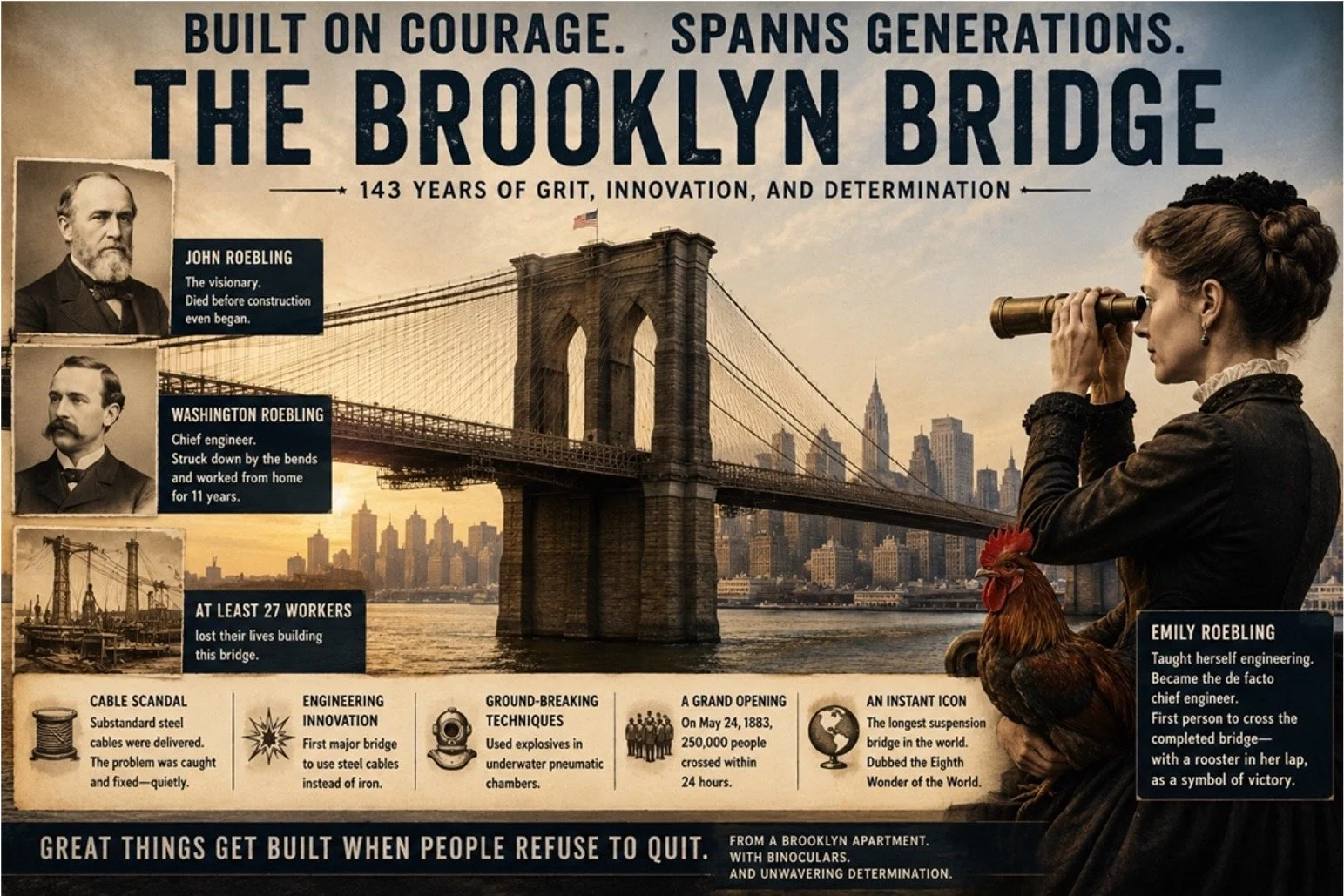
The bridge’s original designer, John Roebling, died before construction even began after a boat crushed his foot during final site measurements. Tetanus followed shortly after.
His son, Washington Roebling, stepped in as chief engineer, only to suffer severe decompression sickness (“the bends”) from repeated trips into the underwater pneumatic caissons used to build the foundations. He became largely bedridden for the remainder of the project, monitoring construction through binoculars from his apartment in Brooklyn Heights.
So who actually carried the bridge across the finish line?
His wife, Emily Roebling.
Emily taught herself advanced mathematics, materials science, and structural engineering. He became Washington’s indispensable liaison to the field teams, contractors, and political officials, effectively serving as the bridge’s operational chief engineer for years. When the bridge finally opened, she was honored as the first person to cross it, famously riding over with a rooster in her lap as a symbol of victory.
There was also a full-blown cable scandal. The contract for the steel suspension cables, the most critical structural element of the entire bridge, went to a Brooklyn supplier that normally manufactured furniture springs and hoop-skirt wire. The company provided substandard materials and tried to hide the fraud. Washington Roebling discovered the issue and quietly ordered additional wire strands added to compensate, preserving the integrity of the structure.
And the bridge itself was revolutionary.
It became the first major suspension bridge built with steel cables rather than iron, and among the first major infrastructure projects to use explosives in underwater pneumatic chambers. The work was extraordinarily dangerous; at least 27 laborers died during construction.
When the bridge finally opened on May 24, 1883, President Chester A. Arthur presided over a celebration unlike anything New York had seen. More than 250,000 people crossed the bridge within the first 24 hours. At the time, it was the longest suspension bridge in the world and was immediately hailed as the “Eighth Wonder of the World.”
The lesson from the Brooklyn Bridge is timeless:
Great things are rarely built under perfect conditions. They get built because people refuse to quit, sometimes from a Brooklyn apartment, armed only with determination, engineering drawings, and a pair of binoculars.
