
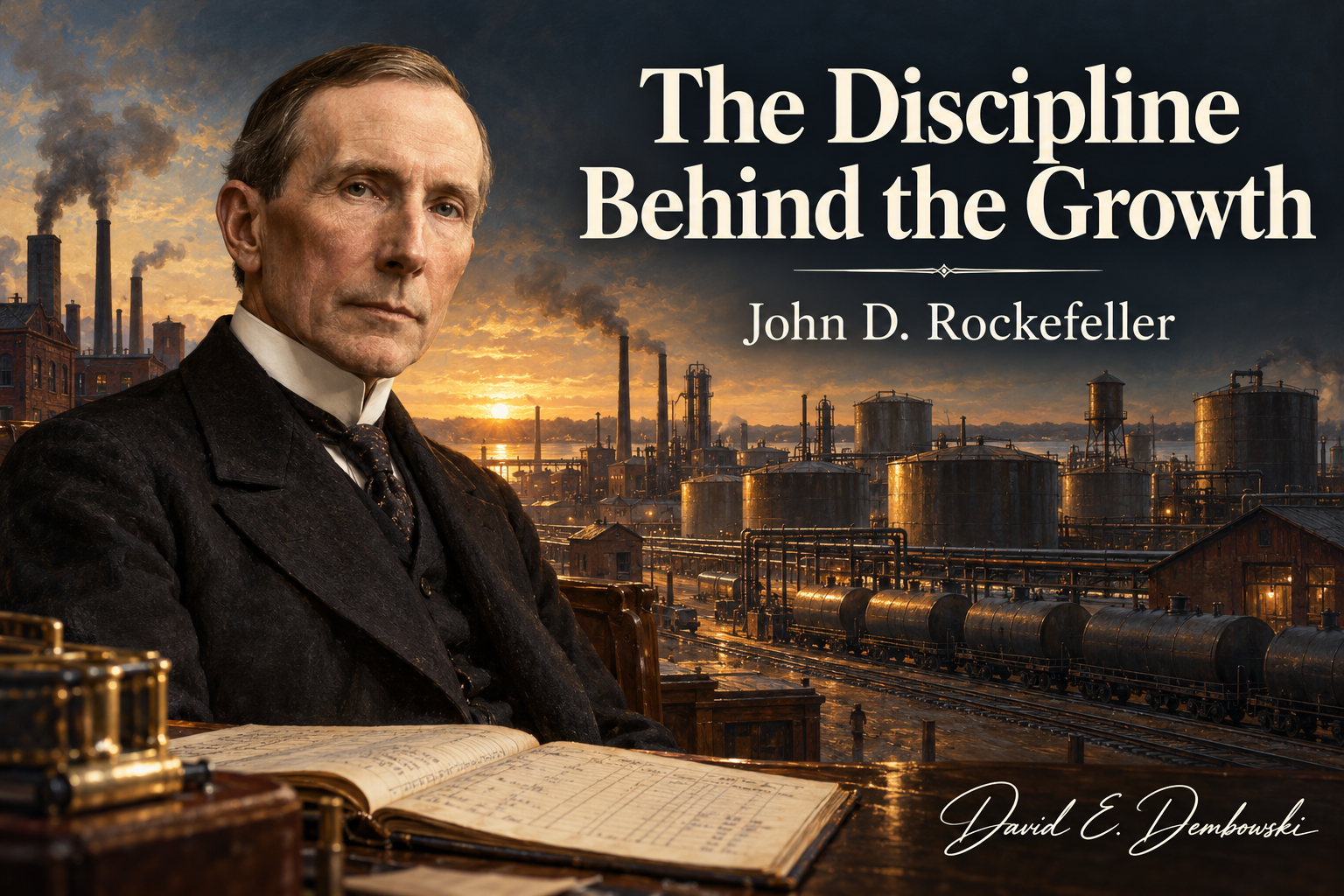
John D. Rockefeller and the responsibility that comes with scale
Growth gets attention. The discipline that sustains it often gets less attention. Leaders celebrate new customers, acquisitions, and record revenue. But beneath those results are decisions about costs, quality, investment, and how consistently an organization delivers.
John D. Rockefeller, to use that power, understood the importance of those decisions. He helped establish Standard Oil in 1870 and built an organization known for its relentless pursuit of efficiency. His career also shows the consequences of letting competitive ambition become an unchecked pursuit of control. His story offers a demanding leadership lesson: building a powerful business requires operating discipline. Leading it responsibly requires judgment about how that power is used.
Understand the economics behind the results.
Rockefeller devoted considerable attention to reducing waste and improving the efficiency of oil refining. He understood that the economics of the operation shaped its ability to compete. That principle remains relevant. Revenue can grow while margins weaken. New customers can arrive faster than an organization can support them. A large contract can look attractive until the cost of implementation, customization, and ongoing service becomes clear.
Leaders need to understand what sits beneath the headline number. Which customers generate durable value? Where does delivery become expensive? Which activities improve the customer experience, and which introduce unnecessary work?
Growth becomes more valuable when you understand what it costs to deliver.
Build an organization that can repeat its success.
Standard Oil expanded through acquisitions and investment in technology. Its development illustrates the importance of coordinating operations as a business grows. For modern leaders, the practical question is whether the organization can deliver consistently as its complexity increases.
A business that depends on exceptional individual effort will eventually encounter limits. Employees spend their time resolving preventable problems. Customers experience uneven service. Managers get pulled into decisions that should be routine. Clear responsibilities, reliable information, and repeatable processes give people the capacity to do better work. Operating discipline should make good performance easier to sustain.
If every success requires a rescue, the organization needs more than another strong quarter.
Recognize the limits of competitive ambition.
Rockefeller's accomplishments cannot be separated from Standard Oil's controversial business practices. In 1911, the Supreme Court found the company in violation of the Sherman Antitrust Act and ordered it broken up. Rockefeller had retired from active leadership in 1896, although he retained the title of president until 1911.
That history matters. Efficiency does not excuse anticompetitive conduct. Financial success does not settle questions about fairness or accountability. As organizations gain influence, leaders need people who can challenge their assumptions and examine the consequences of their decisions. Winning a negotiation or constraining a competitor does not, by itself, establish that doing so is wise.
Power increases the need for scrutiny.
Apply discipline to the value you create for others
Rockefeller also helped establish institutions supporting education, science, medicine, and public health. His philanthropic work developed an organized approach to allocating resources, supported by advisers and institutions.
Leaders at every scale can apply this: good intentions deserve thoughtful execution. Developing employees requires more than encouragement. Improving customer trust requires more than a commitment in a presentation. Supporting a community requires understanding what people need and whether the effort is helping.
The discipline applied to commercial performance can also strengthen an organization's broader contribution. Rockefeller's career offers lessons in both achievement and consequence. Leaders should study both.
The question is larger than how much your business can grow:
Are you building an organization whose performance - and conduct - can stand up to scrutiny?
