
WHAT LEADERS LEAVE BEHIND
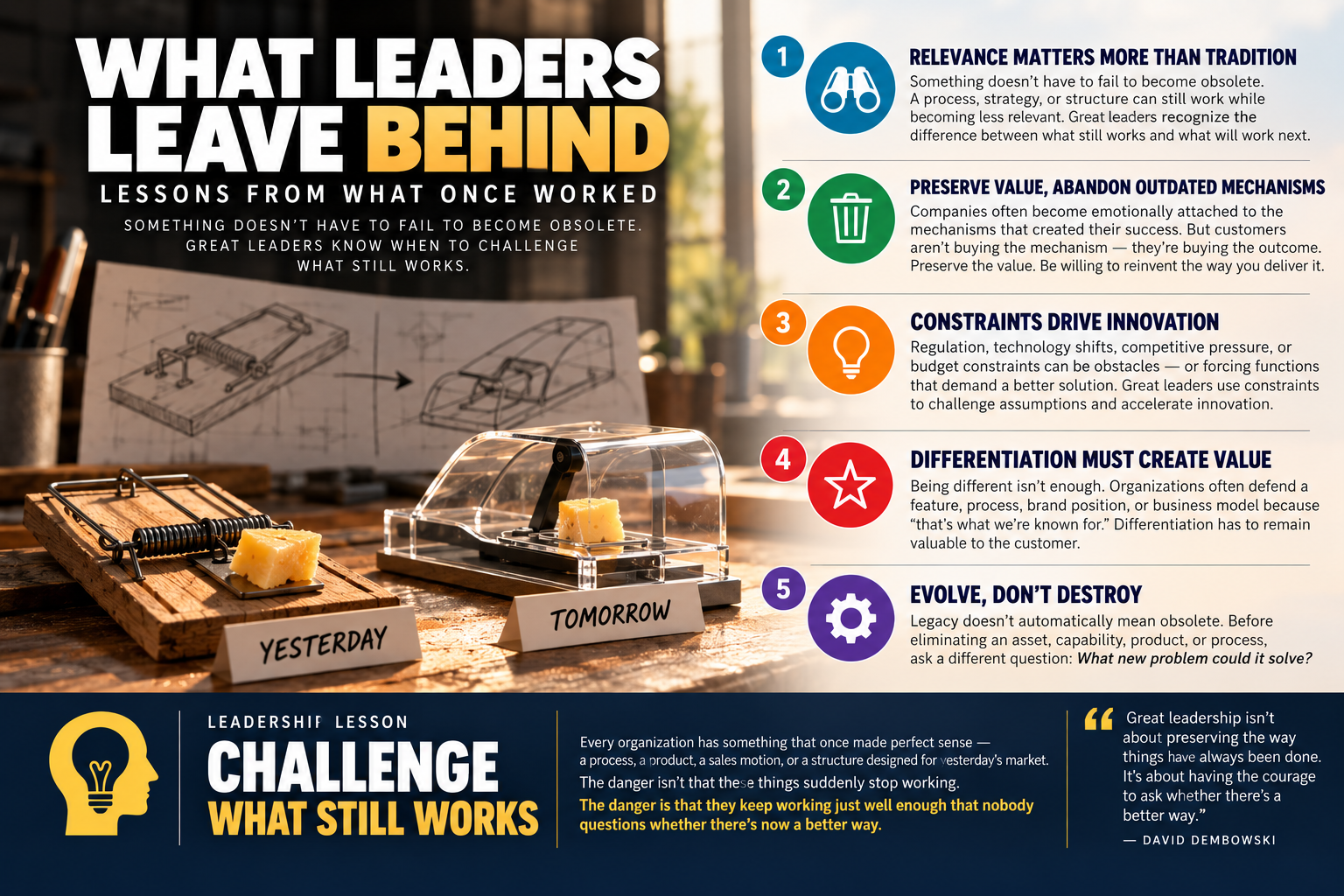
Build a better mouse trap.
1. Relevance matters more than tradition.
Something doesn't have to fail to become obsolete. A sales process, product strategy, organizational structure, or management practice can still work even as it becomes less relevant. Great leaders recognize the difference between what still works and what will work next.
2. Great leaders know what to preserve, and what to abandon.
Companies often become emotionally attached to the mechanisms that created their success. But customers aren't buying the mechanism. They're buying the outcome.
Preserve the value. Be willing to reinvent the way you deliver it.
3. Constraints can create innovation.
Regulation, technology shifts, competitive pressure, and budget constraints can be viewed as obstacles—or as forcing functions that demand a better solution.
Great leaders use constraints to challenge assumptions and accelerate innovation.
4. Don't confuse differentiation with value.
Organizations often defend a feature, process, brand position, or business model because "that's what we're known for.”
But being different isn't enough.
Differentiation has to remain valuable to the customer.
5. The best transformation often looks like evolution, not destruction.
Legacy doesn't automatically mean obsolete. Before eliminating an asset, capability, product, or process, ask a different question: What new problem could it solve?
Leadership Lesson: Challenge What Still Works
Every organization has something that once made perfect sense:
A process built for another era.
A product customers once demanded.
A sales motion that once drove growth.
A structure designed for yesterday's market.
The danger isn't that these things suddenly stop working. The danger is that they keep working just well enough that nobody questions whether there's a better way now.
“Great leadership isn't about preserving the way things have always been done. It's about having the courage to ask whether there's a better way.”- David Dembowski
